

Graduated, and starting a PhD at Sapienza NLP!
I completed my Master’s degree in Foggia with a thesis on Latin lexical semantics, and this fall I am starting a PhD with the Sapienza NLP group in Rome.
PhD student at Sapienza NLP, with a background in Classics and Digital Humanities from the University of Foggia. Bass player and huge fan of open access, orecchiette, haiku, myths and technology used for social good. I work on Word Sense Disambiguation, multilingual semantics and small language models, and I still spend a lot of my time with Latin and Ancient Greek.
Download CVI am a PhD student in Engineering in Computer Science at Sapienza University of Rome, where I am part of the Sapienza NLP group. My research is about semantics, mainly Word Sense Disambiguation and Semantic Role Labeling. I am building linguistically grounded, low-parameter language models for multilingual lexical and predicate-argument semantics; I also study how knowledge transfers between languages in these models, and evaluate them on tasks such as machine translation and diachronic semantic change.
I come to NLP from Classics. I studied Digital Humanities (BA) and Classical Philology (MA) at the University of Foggia, where I have also worked as a research assistant since 2022, and historical languages are still a large part of my work: recent projects include open-vocabulary sense retrieval for Latin and Ancient Greek, a corpus of prosodically accurate Latin poetry read by LLM-based text-to-speech, and the digitisation of a post-war newspaper. I am also a Junior Social Media Editor at the Journal of Open Humanities Data. Collaborations are always welcome - feel free to reach out!
I completed my Master’s degree in Foggia with a thesis on Latin lexical semantics, and this fall I am starting a PhD with the Sapienza NLP group in Rome.
Our Expedition Tiny Aya project on multilingual Word Sense Disambiguation was featured on the Cohere blog.
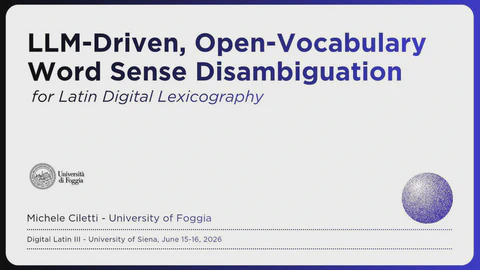
I presented preliminary results on LLM-based Word Sense Disambiguation for Latin at the third Digital Latin workshop in Siena.
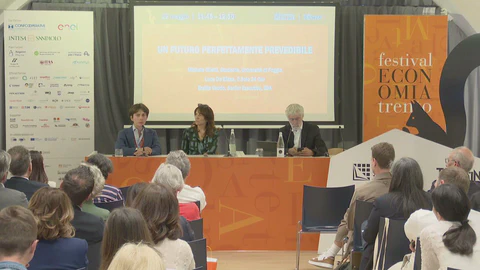
Notes from my panel at the 2026 Festival dell’Economia di Trento, with Luca De Biase and Ersilia Vaudo.
Why historical linguistics is missing its most important data layer, and what we could build next.